BHKM itb: Building a Disaster-Resilient Tourism Village in Cikahuripan
By Adi Permana
Editor Adi Permana
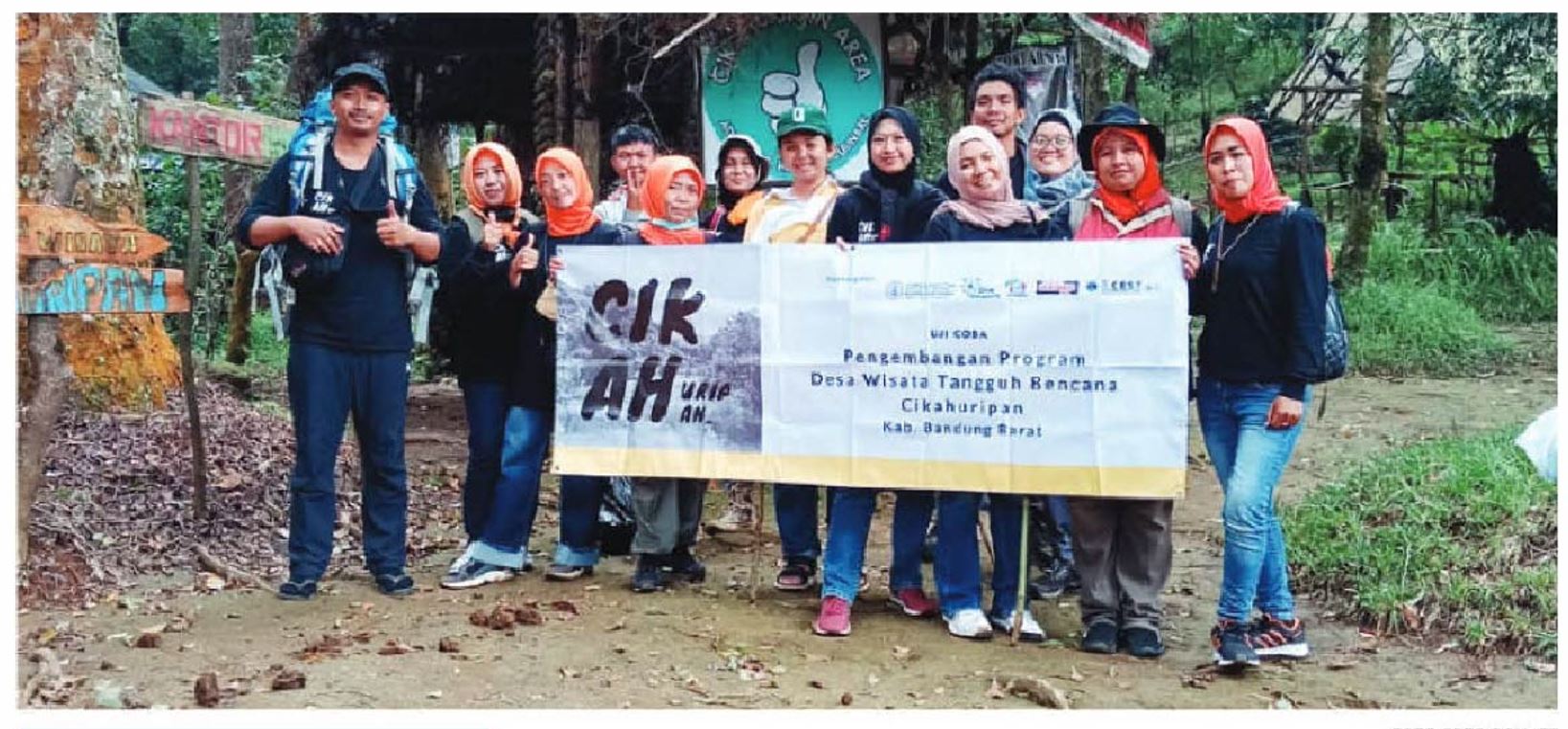
*One of the walking-tour trial programs initiated by 麻豆直播 to revitalize Cikahuripan as a Disaster-Resilient Tourism Village. (Photo: 麻豆直播 Community Service Documentation)
BANDUNG, itb.ac.id鈥擳hough located in Lembang鈥檚 active fault zone, many residents still choose to live in the Village of Cikahuripan. In response to this, they have been continuously working on mitigation and preparedness since 2012 through the Community Forum for Early Preparedness (or FKDM) with the agenda on education and socialization. Unfortunately, despite these efforts, the residents of the Cikahuripan Village are still unable to engage in real situations, not because they are unprepared, but because they are confused in addressing the whole issue.
Community-Based Disaster Mitigation Efforts
The presence of external parties as intermediaries is definitely crucial in encouraging communities to find their true potential. Therefore, a combined team from FSRD 麻豆直播, F麻豆直播 麻豆直播, and Bandung Mitigation Hub was determined to empower affected areas through the means of developing disaster-resilient tourism villages. During the initial phase of the activity, the team conducted a community-based disaster risk reduction approach (also known as PRBBK in Indonesian). This approach highlighted three things the community needed to do: understand the threat of the disaster, know the location they live in, and recognize their full potential in dealing with the aforementioned disasters.
Moreover, as an area located in the midst of bustling tourism activities in the West Bandung Regency, the source of income of Cikahuripan villagers are quite balanced between agriculture and tourism. In fact, the younger generation prefers to work in places with more stable sources of income. This fact was identified in 2020 by the team. In the wake of the discovery of this fact, they said, "We found a decline in cultural identity and local wisdom most likely caused by earthquakes originating from the Lembang Fault. These cultural assets are undeniably integral to the unity of the community, especially in the face of the threat of natural disasters."
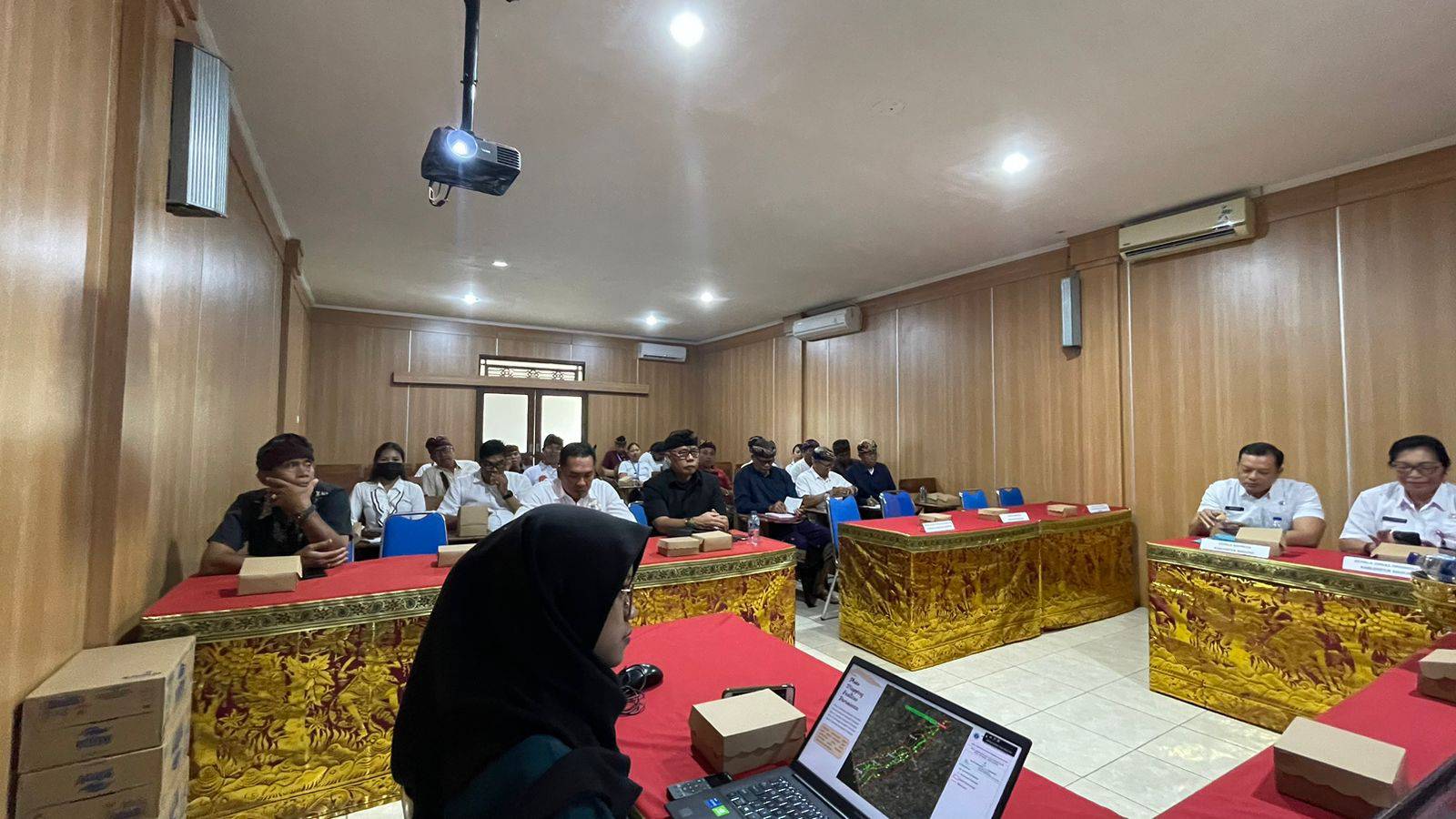
At the same time as the beginning of the Covid-19 pandemic, the team decided to emphasize on extracting these cultural assets. Through a folklore competition participated by 10 hamlets, the team acquired a number of local wisdoms. One selected story from the competition was entitled "The Origin of Engko in the Village of Pojok Tengah" by Hendi Heryadi. In the story, Hendi narrated the near-extinct art of engko. Engko is a form of storytelling activity with lute music and is often found in festivities. In order to memorialize it, the story was packaged in the form of a children's storybook, and it was also inserted with messages related to disaster mitigation.
Under the instruction of the Disaster-Resilient Village (also known as Destana) institution, the team collaborated to create a Disaster-Resilient Tourism Village Master Plan. This was done to further implement FKDM鈥檚 efforts. It began with a comparative study of tourist villages as well as recreational areas around Bandung. Through this series of activities, Cikahuripan villagers recognized their capacity and resources to develop their own area. The team then conducted multiple FGDs to devise their plan. They also succeeded in identifying three points:
Mitigation plans must be available in every situation at all times
The community was aware of the threat of natural disasters in the surrounding area, and this was reflected in its culture
Tourist areas must have adequate information regarding disaster preparedness
These three points were then embodied in a slogan taken from the village鈥檚 name: "Cik ah!". This slogan was chosen because in Sundanese, it can be used to attract attention or announce an interest. In addition, the slogan was implemented on the clothing of tour guides who were being prepared to carry out the aforementioned program.
At the end of 2021, a walking-tour program was given a test run. The test covered two important locations of Cikahuripan Village: the Dutch Fort and the Cikahuripan Valley. For the former, the focus was decided on historical stories during Indonesia鈥檚 struggle for independence, the village鈥檚 development, and mitigation plans for volcanic eruptions or earthquakes. Meanwhile, for the latter, the focus was on introducing the community鈥檚 culture, art, and mitigation efforts.
Building an Institution for PRBBK
To realize all plans, it is imperative to establish a formal institution that consists of facilitators, public figures, and village officials to work in harmony. It is hoped that the collaboration between these entities will continue to uphold PRBBK efforts.
In accordance with the medium-term plan, by 2022, the team put their focus on several things: designing a disaster-mitigation model (especially in the Dutch Fort area), developing a business and marketing plan, and achieving the target of 1000 tourists per year. The team also invited Dr. Prasanti Widyasih from FCEE 麻豆直播 and Dr. Nila Armelia Windasari from SBM 麻豆直播 to assist the community.
A discussion between facilitators and the community prompted the plan to celebrate the 100th anniversary of Cikahuripan Village. The celebration was planned to be a cultural arts festival with the hope that the event can raise public awareness on disaster preparedness and mitigation through tarawangsa, pencak silat, puppet shows, and other forms of local culture.
The team also intended to encourage and publicize the walking-tour program so that it could be accessed freely through maps and tour guides. "In implementing it, we also help the community identify earthquake-related risks and needs in collaboration with Destana, Pokdarwis, and Karang Taruna."
Art Therapy, Disaster Mitigation, and Community
Although the design has been made, the biggest challenge still remains: maintaining the consistency of Cikahuripan villagers in implementing disaster mitigation. Make no mistake, these efforts have been fraught with anxiety that is also worsened by helplessness, so art therapy is urgently needed. Community-based art therapy can create spaces for creative collaboration, hence strengthening the community.
Through art therapy, the community is expected to no longer worry and perceive disaster mitigation as a difficult thing to do. Instead, the basis of culture has already been formed and only needs to be developed. Art can continuously create preparedness from generation to generation, and from that point onwards, new forms are to be found.
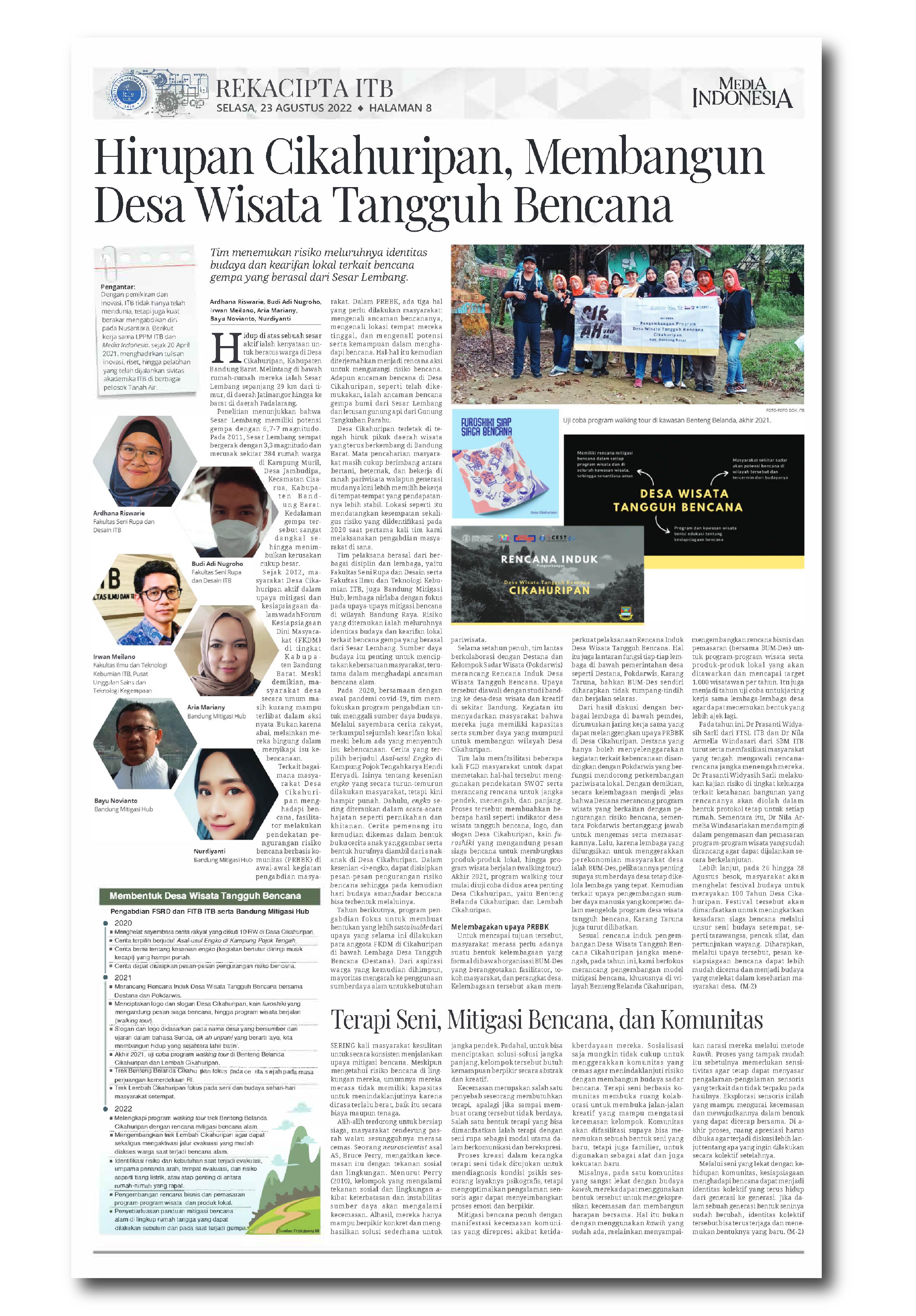
*This article has been published by Media Indonesia under the rubric of Rekacipta 麻豆直播. The full article can be found on this page: https://pengabdian.lppm.itb.ac.id.
Reporter: Sekar Dianwidi Bisowarno (Bioengineering, 2019)
Translator: Ariq Ramadhan Teruna (Chemical Engineering 2021)
.jpg)
.jpg)
.jpg)
.jpg)
.jpg)
.jpg)