Touching the Skies of Ramadan: Â鶹ֱ²¥â€™s Bosscha Observatory Hosts Virtual Total Lunar Eclipse Observation 2026
By Ahza Asadel Hananda Putra - Teknik Pangan, 2021
Editor M. Naufal Hafizh, S.S.
.jpeg)
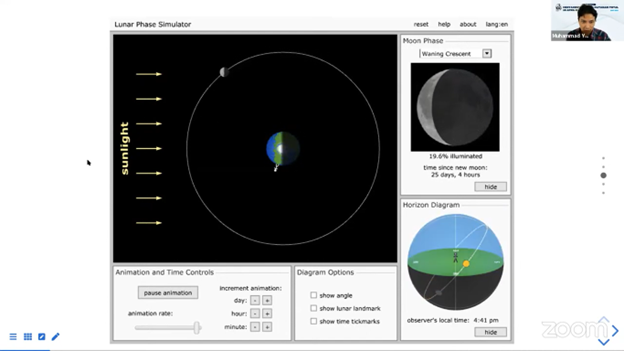
BANDUNG, itb.ac.id – Amidst the solemn atmosphere of the holy month of Ramadan, a breathtaking natural phenomenon graced the Indonesian skies. On Tuesday night (3/3/2026), Institut Teknologi Bandung (Â鶹ֱ²¥), through the Bosscha Observatory, hosted a virtual observation event titled "Virtual Night Sky Observation (PVLM): Total Lunar Eclipse."
The event, broadcast live on the Bosscha Observatory’s official YouTube channel, was hosted by two educator staff members, Dimas Gilang Ramadan (Kak Dimas) and Fatimah Zahra (Kak Zea). Despite the cloudy weather in Lembang, the team successfully captured crucial moments as the Moon entered the Earth’s shadow.
The Science Behind the "Blood Moon"
During the educational session, Kak Dimas explained that a Total Lunar Eclipse (TLE) occurs when the Sun, Earth, and Moon are perfectly aligned. This celestial alignment causes the Moon to pass into the Umbra, the darkest part of Earth’s shadow.
One of the main attractions of a TLE is the Moon’s transformation into a reddish hue, often referred to as a "Blood Moon."
"This red color occurs because Earth's atmosphere scatters blue light and only allows red light to pass through and be refracted onto the Moon's surface," Kak Dimas explained.
The brightness and shade of this red hue are measured using the Danjon Scale, where Earth’s atmospheric conditions—such as pollution or volcanic ash—significantly influence how dark or bright the Moon appears during totalitas.
Technology and Heritage in Lembang
As the oldest scientific institution in Indonesia, now over a century old, Bosscha Observatory utilizes modern equipment to deliver high-quality imagery to the public. This observation relied on:
- Refractor Telescope: Featuring a 6.15 cm diameter lens.
- Imaging Gear: DSLR cameras and panoramic cameras to monitor weather conditions in the eastern horizon.
- Global Contribution: Image data from Bosscha was also shared with the Slooh Observatory network as part of an international astronomical collaboration.
Cultural Perspectives and a Message of Peace
Beyond the scientific technicalities, this PVLM session highlighted the humanities through folklore. The discussion ranged from the Batarakala myth in Java and Bali—where a giant is believed to "devour" the Moon—to the traditions of the Batamariba people in Africa, who view an eclipse as a time to reconcile and resolve human conflicts.
This momentum felt particularly relevant as it coincided with the month of Ramadan and neared several other religious holidays in Indonesia. The observation concluded with a message of tolerance, inviting the public to unite under the same shared sky.
Future Astronomical Records
For those who missed the event, Bosscha Observatory noted that this GBT is the only total lunar eclipse visible from Indonesia in 2026. A similar phenomenon will not grace Indonesian skies again until December 31, 2028.
Â鶹ֱ²¥ remains committed to providing inclusive science for the public. To monitor other celestial events, the public can access the 2026 Astronomical Calendar via the official website at bosscha.itb.ac.id.
.jpg)
.jpg)
.jpg)
.jpg)
.jpg)