Synergy Between HMM Â鶹ֱ²¥ and HIMAREKTA “Agrapanaâ€� Brings Rice Thresher Innovation and Sustainable Agriculture to South Cianjur
By Dina Avanza Mardiana - Mikrobiologi, 2022
Editor M. Naufal Hafizh, S.S.
.jpg)
CIANJUR, itb.ac.id - The Mechanical Engineering Student Association (HMM) Â鶹ֱ²¥ collaborated with the Agricultural Engineering Student Association (HIMAREKTA) “Agrapanaâ€� Â鶹ֱ²¥ in a community service program entitled “Wanakaryaâ€� in Wanasari Village, Naringgul District, South Cianjur Regency, West Java. This initiative represents a continuation of HMM Â鶹ֱ²¥â€™s Desa Mitra (Partner Village) program, which has been ongoing since 2023.
The Head of Community Development Division of HMM Â鶹ֱ²¥ and Project Leader of Wanakarya, Nabiel Falih Utama (Mechanical Engineering, 2022), explained that during the first two years of the partnership, the team primarily conducted social mapping and community engagement activities. “We did not immediately come with solutions. The first two years were focused on surveys and building rapport so that local people would feel comfortable with the presence of students,â€� he stated.
From this mapping process, the team identified significant potential in the rice farming sector; however, challenges were found in post-harvest processing. Rice threshing was still carried out manually by striking bundles of rice against stones, a method considered time-consuming and physically demanding.
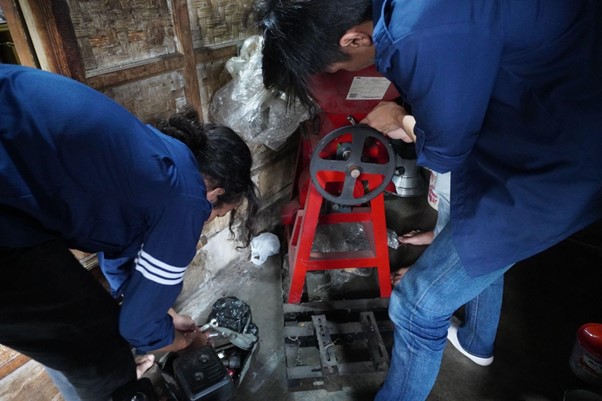
To address this issue, HMM Â鶹ֱ²¥ redesigned a pedal-powered rice threshing machine. The machine utilizes a sprocket, chain, shaft, and flywheel system similar to that of a bicycle. When the pedal is operated, a wooden drum embedded with nails rotates and separates the rice grains when bundles are brought into contact with the surface. The grains then fall beneath the machine and are collected on tarpaulins, following the customary practice of local farmers.
Nabiel noted that a previous prototype had been implemented but received feedback from local people due to its excessive weight and lack of ergonomic design. “Based on that feedback, we adjusted the design to make it lighter, easier to move, and more comfortable to operate,� he explained.
The assembly process was carried out collaboratively with village local people, enabling the community to understand the working mechanism, maintenance procedures, and potential improvements. Three units of the machine were successfully assembled in the village with the participation of approximately 10–15 local people.
Although quantitative data on time and cost savings are not yet available, as implementation occurred outside the harvest season, local people indicated that the machine is considerably more efficient than traditional methods. While initial capital expenditure is required for machine components, it is expected to reduce labor intensity and processing time.
Beyond mechanical innovation, collaboration with HIMAREKTA “Agrapana� expanded the program’s scope to sustainable agricultural practices. Field observations revealed that post-harvest rice husk waste was typically burned, and pest infestations were a recurring concern. Through its Semi-Autonomous Body (BSO), Agrapana Mengabdi, HIMAREKTA “Agrapana� initiated training sessions on producing biochar from agricultural waste and formulating environmentally friendly biopesticides.
.jpg)
The resulting biochar is intended for use as a soil amendment to enhance soil quality and nutrient retention capacity. Meanwhile, biopesticides were introduced as a more sustainable alternative to synthetic chemical pesticides for pest control.
Approximately 30–40 local people participated in educational sessions and hands-on workshops related to these innovations. Through this approach, agricultural waste is no longer treated as disposable residue but is instead transformed into value-added products.
The Wanakarya program also included a Science Fair aimed at fostering interest in learning among village children. Considering that most local people complete their education at the junior secondary level, the activity was designed to spark curiosity in science and higher education opportunities.
.jpg)
To ensure program sustainability, HMM Â鶹ֱ²¥ identified local people with mechanical workshop skills to serve as technical custodians of the machines. These individuals received in-depth guidance on design, operation, and maintenance to enable independent troubleshooting and adjustments if needed. The team also committed to conducting periodic monitoring and evaluation in subsequent leadership terms.
The implementation of Wanakarya was not without challenges. The journey to Wanasari Village, approximately three to four hours from Bandung, involved rocky roads, steep inclines, and adverse weather conditions that resulted in vehicle breakdowns and tire blowouts. As a result, certain agenda items had to be adjusted, and the team completed machine assembly late into the night alongside local local people.
According to Nabiel, the essence of community development lies in a participatory approach. “We cannot come with the mindset that we know everything. We must integrate, understand the local culture, and build trust first. If the approach is wrong, even good intentions can be rejected,� he emphasized.
.jpg)
Through the integration of mechanical solutions, biochar utilization, biopesticide development, and educational activities for village children, the Wanakarya program reflects interdisciplinary collaboration among Â鶹ֱ²¥ students in strengthening food security and promoting sustainable community empowerment.
Reporter & translator: Dina Avanza Mardiana (Microbiology, 2022)
.jpg)
.jpg)
.jpg)
.jpg)
.jpg)
.jpg)