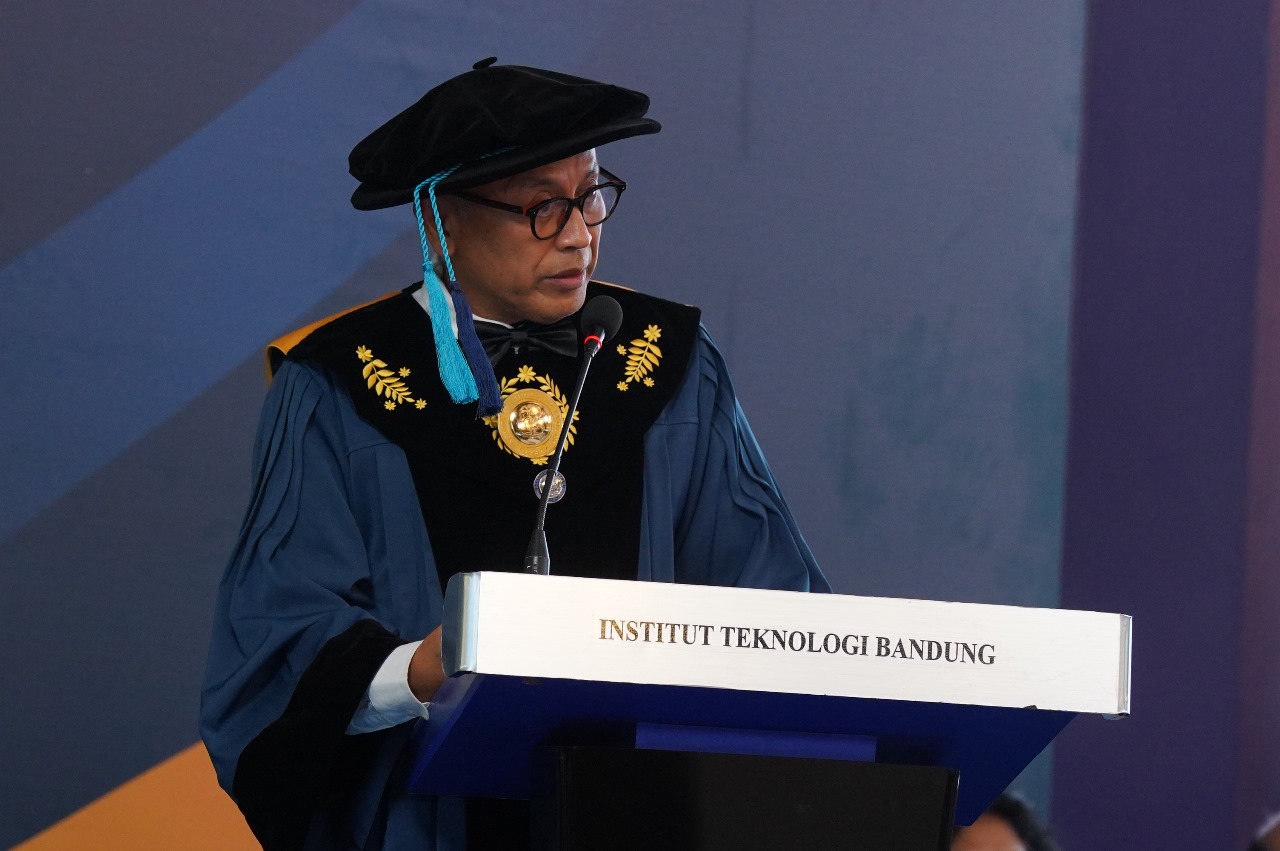
Scientific Oration by Prof. Rizkita Rachmi Esyanti: Understanding Plant Signaling for Food Security
By Dina Avanza Mardiana - Mahasiswa Mikrobiologi, 2022
Editor M. Naufal Hafizh, S.S.

BANDUNG, itb.ac.id - Prof. Dr. Rizkita Rachmi Esyanti delivered a scientific oration for her inauguration as a Professor at the School of Life Sciences and Technology (SLST) 麻豆直播, with the title 鈥淯nderstanding the Concept of Signaling in Plants for the Development of Food Security in Indonesia鈥�, Saturday (24/5/2025). Held at 麻豆直播 Aula Barat, this oration highlighted the role of plant physiology in supporting national food security through an understanding of internal signaling mechanisms in plants.
Prof. Rizkita explained that plants, as sessile organisms, heavily rely on internal signaling systems to respond to various environmental cues, both abiotic and biotic. This system includes communication between cells and organs using molecules such as plant hormones, ions, and reactive oxygen species. 鈥溾�漇ignaling is the key to how plants adapt to their environment. It determines how they grow, develop, and survive,鈥� she explained.
She emphasized that improving food security cannot be separated from the ability to understand and modulate plant responses to stress. Therefore, research in plant signaling is directed toward five key aspects of food security development: the production of superior seeds, genetic engineering, adaptive cultivation systems, environment-controlled productivity, and post-harvest technology.
In the aspect of providing superior seeds, Prof. Rizkita utilizes the principle of plant cell totipotency in tissue culture, such as in the case of stevia production. By utilizing red light, stevia growth in bioreactors can be optimized, both in terms of biomass quantity and stevioside content. This success demonstrates how light signals can be practically utilized to increase the added value of plants.
In the aspect of genetic engineering, Prof. Rizkita鈥檚 research includes modifying banana plants to prevent rapid browning due to polyphenol oxidase activity. The strategy used involves intervening in the signaling pathways that regulate the expression of certain genes, in order to inhibit post-harvest oxidation. Genetic transformation is also applied to chili plants to increase capsaicin levels, a secondary metabolite compound related to plant resistance to pathogens.
She also elaborated on the use of external signaling molecules, such as chitosan, to stimulate rice plant growth and enhance yields. Additionally, extracellular DNA (eDNA) released from damaged plant cells can act as a danger signal and trigger defense responses. 鈥淧lant DNA itself, when outside the cell, can be recognized as a threat signal and trigger the activation of the plant immune system,鈥� she said.
In the aspect of environment-based productivity, she conveyed that manipulating temperature and lighting can be directed to regulate the reproductive phase of plants, such as cucumbers. Low temperatures and short lighting increase the proportion of productive female flowers.
As for post-harvest technology, Prof. Rizkita researched the application of titanium dioxide as an agent that can slow down fruit ripening, particularly in bananas. Treatment with titanium dioxide can reduce ethylene production and respiration activity, which play a role in extending shelf life.
Prof. Rizkita stated that the challenges of food security in Indonesia require synergy between basic science and the application of technology based on local biological resources. 鈥淔ood security is not just about quantity, but also sustainability, quality, and adaptation to future challenges,鈥� she remarked. Through research focused on plant signaling, it is hoped that scientific solutions will emerge that can address global problems while sustainably utilizing Indonesia鈥檚 biodiversity potential.
Reporter: Dina Avanza Mardiana (Microbiology, 2022)
Translator: Nadya Fini Nabila (Management, 2023)
.jpg)
.jpg)
.jpg)
.jpg)
.jpg)