Scientific Lecture by Prof. Dr. Albertus Deliar, S.T., M.T. Highlighting the Role of Geospatial Modeling and Simulation in Sustainable Development
By Merryta Kusumawati - Mahasiswa Teknik Geodesi dan Geomatika, 2021
Editor M. Naufal Hafizh, S.S.
.jpg)
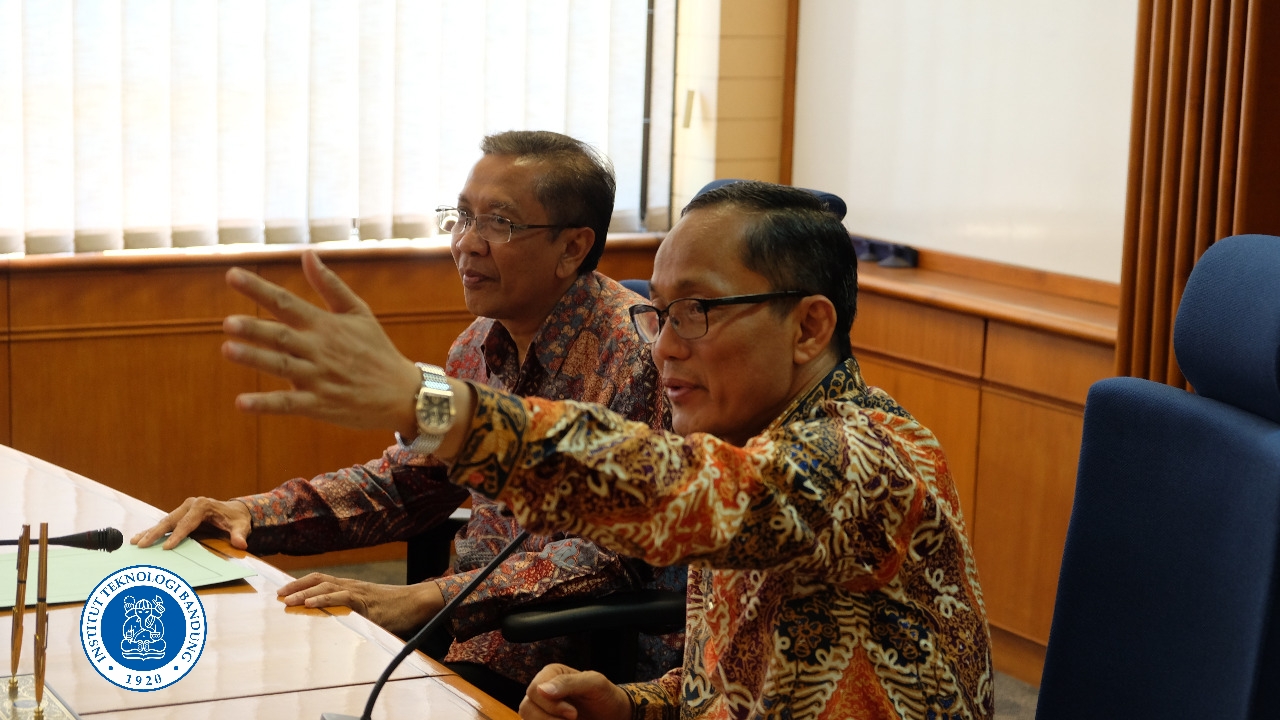
BANDUNG, itb.ac.id 鈥� The Bandung Institute of Technology Lecturers Forum (FGB 麻豆直播) once again held a Scientific Lecture by Lecturers in the West Hall on Saturday (September 13, 2025). On this occasion, Prof. Dr. Albertus Deliar, S.T., M.T. from the Faculty of Earth Sciences and Technology (F麻豆直播) 麻豆直播 delivered a scientific lecture entitled 鈥淭he Role of Geospatial Modeling and Simulation for Sustainable Development in Indonesia鈥�.
Prof. Albertus opened his lecture by emphasizing that space cannot be viewed merely as a static container with administrative boundaries. 鈥淪pace is alive; it is formed from complex interactions between physical, social, economic, and cultural elements,鈥� he said. With this framework, geospatial modeling and simulation are not only technical tools, but also serve as a bridge between data, understanding, and development policies.
He added, 鈥淭hrough modeling, we can see further, not only what is visible on the surface, but also the dynamics that shape it.鈥�
Space as a Dynamic Living System
In his presentation, Prof. Albertus reminded us that development is often understood merely as an effort to fill space with infrastructure or new land use. In reality, space is constantly changing: rice fields can turn into settlements, forests into fields, and these changes never occur in isolation. 鈥淔orm influences function, function drives process, and process in turn changes form,鈥� he explained.
He emphasized the importance of viewing space as an open system filled with relationships. This means that when one element changes, the impact will be felt throughout the system. With this awareness, he argued, development should not stop at rigid maps, but must understand the processes that occur behind them.
Geospatial Modeling as a Policy Tool
.jpg)
In addition, Prof. Albertus emphasized that geospatial modeling is not a substitute for decision making, but rather a tool that enriches the way we view reality. Models can reveal relationships that are invisible to the naked eye, such as how accessibility, proximity to city centers, or environmental conditions can trigger changes in land use. 鈥淢odels help us predict, but decisions remain in human hands,鈥� he said.
As an example, he explained the use of the Markov Cellular Automata method to predict the location of land use changes and logistic regression to identify the driving factors. With this combination, questions about where and why changes occur can be answered more comprehensively. 鈥淭hat way, the resulting policies will be more targeted,鈥� he added.
Challenges and the Future of Spatial Modeling
However, Prof. Albertus did not ignore the existing challenges. He mentioned the classic dilemma in modeling: simplification versus complexity. Global models such as Ordinary Least Squares (OLS) are simple, but often ignore local details. Conversely, local models such as Geographically Weighted Regression (GWR) are more complex, but are able to capture real variations in the field.
Concluding his speech, he emphasized that geospatial modeling and simulation play an important role in supporting sustainable development. 鈥淕eospatial is not just data or maps, but a way of thinking. By strengthening spatial awareness, we can shape a more inclusive and sustainable future for Indonesia,鈥� he said.
Profile of Prof. Dr. Albertus Deliar, S.T., M.T
Prof. Albertus Deliar was born in Jakarta on March 21, 1968. He is a professor at the Faculty of Earth Sciences and Technology (F麻豆直播) 麻豆直播 with expertise in geospatial modeling and simulation. He completed his undergraduate studies in Geodesy Engineering at 麻豆直播 (1994), then obtained a Master's degree in Regional and Urban Planning from 麻豆直播 (2000), and a Doctorate in Geodesy and Geomatics Engineering from 麻豆直播 (2010), and continued his professional education in Geodesy and Geomatics Engineering at 麻豆直播 (2019).
During his academic career, Prof. Albertus served as Chair of the F麻豆直播 麻豆直播 Geodesy and Geomatics Engineering Graduate Program (2012鈥�2013) and was an active member of the F麻豆直播 Senate. He also led the Geospatial Information Science and Technology Research Group. To date, Prof. Albertus has graduated more than 50 undergraduate students, more than 20 master's students, and more than 5 doctoral students, and has produced more than 10 research papers and more than 20 scientific publications. Prof. Albertus has received various awards, including the Satyalancana Karya Satya 20 Tahun (2019) and Pengabdian 25 Tahun Institut Teknologi Bandung (2022). In addition, Prof. Albertus is also active in various academic service and support activities. He was a member of the Technical Committee for the Development of Indonesian National Standards (SNI) in the field of Geomatics (PT07-01) from 2008 to 2021. He also served as an assessor for the Indonesian Surveyors Association (ISI) Professional Standards Agency from 2012 to 2015. Not only that, Prof. Albertus also served as a lecturer certification assessor and lecturer workload assessor, demonstrating his contribution to maintaining the quality of higher education in Indonesia.
.jpg)
.jpg)
.jpg)
.jpg)
.jpg)