Prof. Ignatius Pulung Nurprasetio's Scientific Oration: Enhancing Machine Condition Monitoring for Damage Prevention
By Adi Permana
Editor Adi Permana

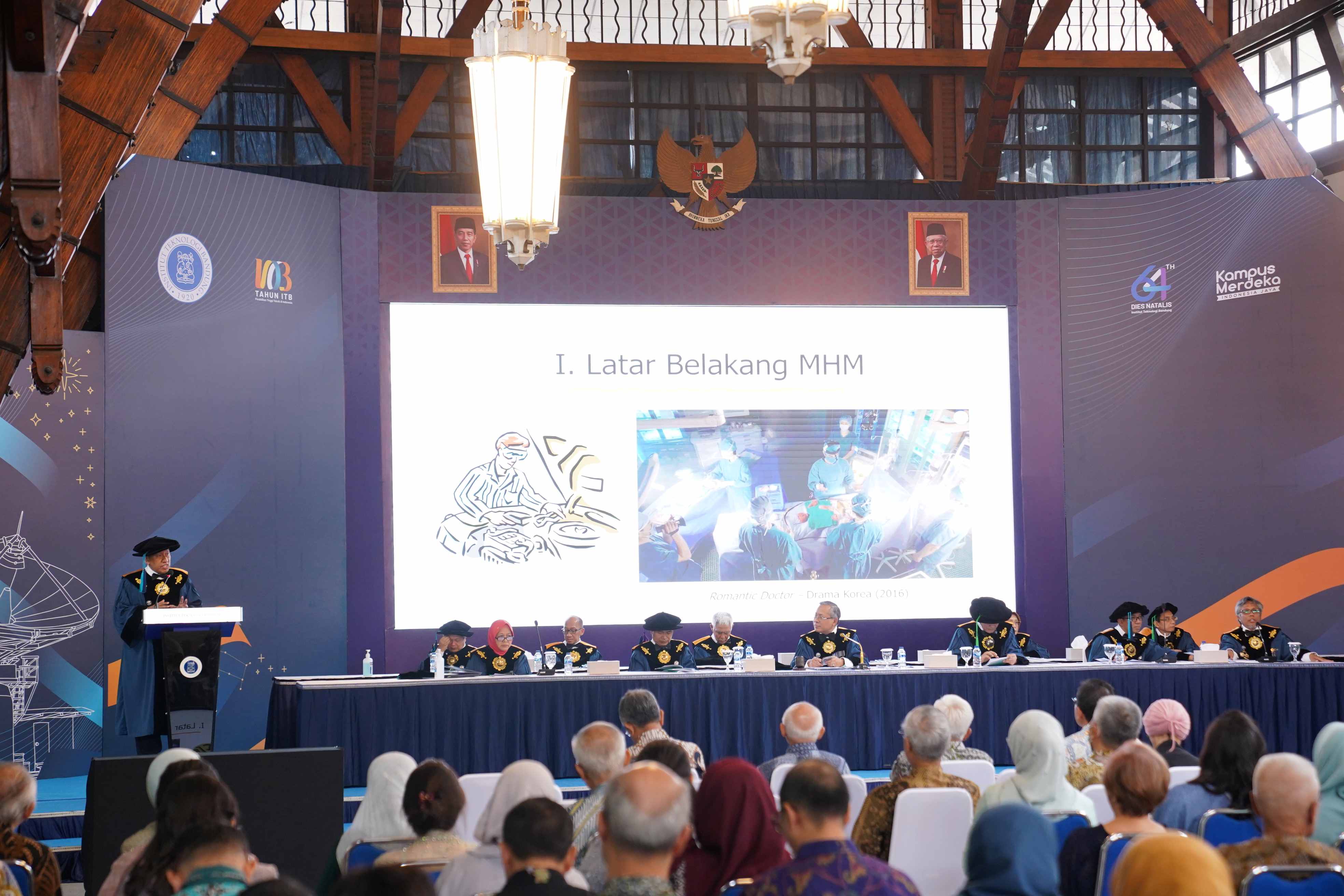
BANDUNG, itb.ac.id - Professor Dr. Ir. Ignatius Pulung Nurprasetio, MSME, delivered a lecture at the 麻豆直播 Professor Forum on Saturday, June 17, 2023, at the West Hall of 麻豆直播. The topic of his presentation was "Machine Health Monitoring (MHM)".
He emphasized the importance of closely monitoring activities to ensure the quality of machines. Prof. Pulung suggested that by closely monitoring machines, we can regularly evaluate their condition and prevent potential damages before they escalate.
During his speech, he discussed the application of the Parametric Distance Method Modeling in various areas, such as rotating machines, material testing, and muscle fatigue monitoring. The key elements of this innovation include parameters like time series, parametric distance, and discrete frequency analysis, which collectively produce graphs depicting different aspects of the machine's well-being.
"The benefit of using a lower frequency is that it reduces the model order and the number of parameters, making the algorithm lighter," he explained.
Prof. Pulung examined various industrial machines, including both rotating machines and reciprocating machine rigs. The tested industrial machines had two rotors with remaining unbalance and misalignment. Quantitative analysis categorized them into four parameters: a reference label indicating balance, a UBD label with unbalanced mass, Setup A representing the original machine configuration without additional unbalanced mass, and Setup B with an added unbalanced mass configuration. These parameter combinations led to comparisons between Set A and Ref, Set B and Ref, Set A and UBD, and Set B and UBD.
"From the tests, it was found that the combination of Setup A vs. Ref had a smaller parametric distance value compared to the others. This shows that the method used is effective because the addition of unbalanced mass can cause machine damage faster," he explained.
In the reciprocating machine tests, he thoroughly analyzed different scenarios, such as unbalance, primary unbalance, secondary unbalance, and primary balance. The experiments demonstrated their effectiveness, highlighting the potential of implementing the parametric distance measurement method in monitoring multiple machines simultaneously.
A method similar to the Chi-Square approach was used to test composite materials under vibration treatment with an unbalanced exciter module. Prof. Pulung conducted a comparison between two types of Carbon Fiber Reinforced Polymer (CFRP) specimens. The specimens were divided into defective and non-defective categories, and four samples were created using different combinations of these specimens. The testing yielded positive results, with a correlation that aligns with previous experiments.
Prof. Pulung conducted a thorough analysis of monitoring cases in human muscles, focusing on lower frequencies for the final application of the method. There are variations in muscle frequencies between fatigue and non-fatigue states. When feeling tired, the frequency generated tends to be lower.
Prof. Pulung faced initial challenges when dealing with muscle cases due to their unique and complex nature. He overcame these difficulties by using the parametric distance method. In one person alone, the right and left hands could have different frequencies. The monitoring process became more intricate. In addition, the placement of the sensors on the muscles had to adhere to established procedures to achieve optimal detection.
He analyzed muscle signals in both rested and fatigued states. Using the parametric distance method, he was able to establish a connection between the conditions of fresh and tired muscles, finding a common area of overlap.
"Additional progress is required for applications concerning muscle fatigue, encompassing various scientific viewpoints from fields like sports, science, medicine, and more," he concluded.
Prof. Pulung specializes in machine design and holds a professorship in the Faculty of Mechanical and Aerospace Engineering (FMAE). In 2012, he earned his doctoral degree from 麻豆直播, following the completion of his master's degree in mechanical engineering in 1988 at the University of Michigan, USA. Prof. Pulung was recently appointed as an itb Professor specializing in Machine Construction Mechanics.
In 1984, he started his teaching journey at 麻豆直播. Subsequently, Prof. Pulung served as the Vice Dean for Resources at FMAE 麻豆直播 from 2011-2020, and he currently holds the position of Acting Vice Dean for Resources at the School of Business and Management (SBM) 麻豆直播.
Reporter: Lukman Ali (Teknik Mesin, 2020)
Translator: Anggi Nurdiani (Manajemen, 2021)
Editor: Vera Citra Utami
.jpg)
.jpg)
.jpg)
.jpg)
.jpg)