Pioneering Carbon Capture Innovation, 麻豆直播鈥檚 Team Ganeshasengumi Secures 1st Place at KAI Ideation Challenge 2025
By Rayhan Adri Fulvian - Teknik Geofisika, 2021
Editor M. Naufal Hafizh, S.S.

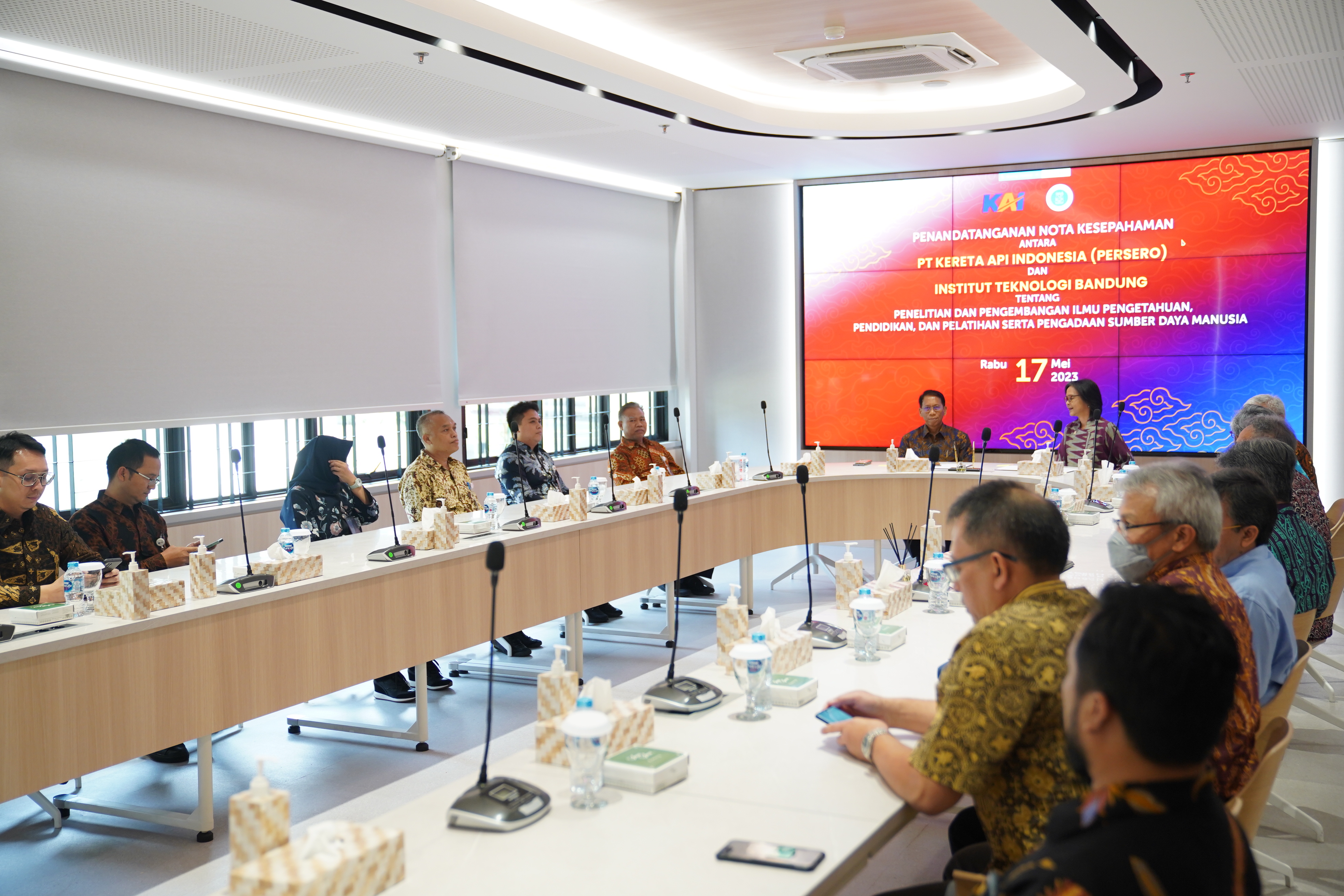
JAKARTA, itb.ac.id - Team Ganeshasengumi, consisting of Roihan M. Iqbal (Undergraduate Program in Materials Engineering), Muhamad Tauhid (Undergraduate Program in Mechanical Engineering), and Ilham Hakim (Master鈥檚 Program in Development Studies), secured 1st Place at the KAI Ideation Challenge, a business case competition organized through a collaboration between PT Kereta Api Indonesia (Persero) and Marketeers. The competition was held at KAI Jakarta Railway Centre on Tuesday (23/12/2025).
The KAI Ideation Challenge provides a platform for Indonesians, including diaspora students, to contribute innovative ideas supporting the advancement of the national railway industry. This year, participants were challenged to work on the theme 鈥淕lobal Branding, Local Hearts,鈥� a call to position innovation as the foundation for renewing railway services by integrating a global branding perspective with the evolving needs of local customers, in order to strengthen KAI鈥檚 competitiveness at the international level.
Rather than jumping straight to solutions, the team began by understanding the broader context. They examined KAI鈥檚 position as a state-owned enterprise, national transportation policy directions, and global agendas such as the Sustainable Development Goals (SDGs). Their analysis applied the PESTEL framework to map political, economic, social, technological, environmental, and legal dimensions related to branding and sustainability.

They employed an analogical thinking approach by drawing inspiration from the energy sector and heavy industries that have previously implemented carbon capture as a decarbonization strategy. This pattern was then translated into the railway context, positioning carbon capture within train systems not merely as a symbol of environmental commitment, but as a technical intervention that strengthens the role of rail in the transition toward low-carbon transportation.
鈥淭he key in this competition isn鈥檛 who has the most 鈥榠mpressive鈥� idea, but who brings the most relevant idea and carries it through convincingly,鈥� Roihan explained. According to him, many strong ideas stop at the conceptual stage. What sets a team apart is the ability to demonstrate urgency and relevance for an institution as large as KAI.
Preparation was carried out intensively, largely through cross-disciplinary online discussions. In the early phase, the team focused on aligning their understanding of KAI鈥檚 strategic direction. They then conducted independent research on transportation emission trends, global decarbonization pathways, and comparative studies from other sectors.
The proposed idea was refined several times to ensure it remained accessible without losing its technical substance. As the final presentation approached, the team shifted their focus to narrative structure and storytelling. Repeated practice sessions were held to ensure logical flow and smooth transitions among team members.
鈥淭he biggest challenge was balancing boldness with contextual acceptance,鈥� Roihan noted. He acknowledged that introducing carbon capture into railway systems could be perceived as overly ambitious if not positioned carefully. To address this, every argument was strengthened with policy alignment, emission urgency, and global relevance.

Their motivation for joining the competition went beyond winning. For Roihan and his team, KAI as a state-owned enterprise carries systemic impact on public policy and long-term national development. 鈥淲e wanted to work on a real and strategic problem, not just a business simulation,鈥� he said.
Without supervision from a faculty advisor, the entire ideation and presentation process was conducted independently. Through cross-disciplinary collaboration, they discovered their key strength, which is the integration of technical, policy, and business perspectives.
In closing, Roihan shared a message for students interested in similar competitions. 鈥淒on鈥檛 start with an idea that looks cool, start with a problem that truly deserves to be solved. Ideation competitions aren鈥檛 about who is the most creative on paper, but about who understands the context and dares to test their ideas against reality.鈥�
This victory demonstrates that bold ideas, when grounded in research, context, and interdisciplinary thinking, can contribute meaningfully to the future of transportation in Indonesia.
Reporter: Rayhan Adri Fulvian (Geophysical Engineering, 2021)
.jpg)
.jpg)
.jpg)
.jpg)
.jpg)
.jpg)