Developments in Artificial Intelligence Research at Ā鶹ֱ²„ during COVID-19 Pandemic
By Adi Permana
Editor Adi Permana
BANDUNG, itb.ac.id ā€“ The Artificial Intelligence (AI) advancements have made significant contributions in many ways, especially during the COVID-19 pandemic with the outbreak starting in Indonesia from March 2020. AI research in the midst of the pandemic focuses on delivering prompt responses to the unprecedented situation and strives to immediately collect and process data.
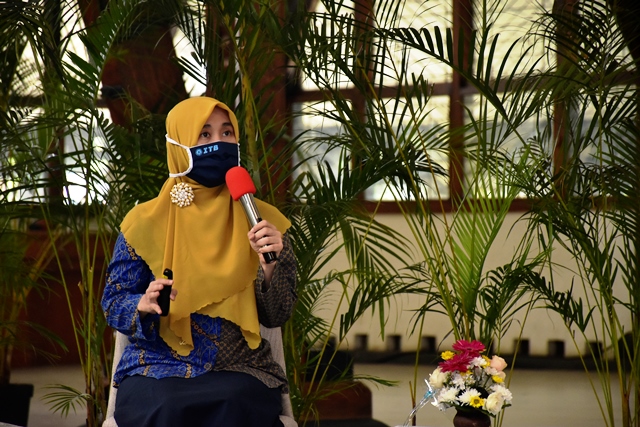
During the Ā鶹ֱ²„ Talks event, a lecturer of Computer Science/Informatics Study Program, from the School of Electrical Engineering and Informatics (STEI) Ā鶹ֱ²„, Dr. Eng Ayu Purwarianti, S.T., M.T., stated that research collaboration especially during the pandemic is imperative due to the arising problems during these trying times that have impacted all aspects of life.
She added that AI can be utilized to process structured data and unstructured data which may involve other parties, namely Domain Expert and AI Algorithm Expert. Data obtained from data processing is an actionable insight which will become a source of reference for policy makers to choose the best decisions to save people. ā€œAI will not replace human beings, but it will support professionals to make decisions and considerations in their respective areas of work,ā€ she explained, Wednesday (18/8).
The pandemic has not only influenced peopleā€™s health and well-being, but it has also impacted the nationā€™s economy. As a consequence, the publicā€™s purchasing power has continuously dropped in the past few months. Responding to this phenomenon, Ā鶹ֱ²„ā€™s AI Center designed an AI simulation to study peopleā€™s level of consumption or what is called as Nowcasting Daya Beli Masyarakat (Nowcasting Peopleā€™s Purchasing Power). Together with the Ministry of National Development Planning (PPN/Bappenas), Nowcasting Daya Beli Masyarakat aims to create a nowcasting model to estimate peopleā€™s purchasing power in certain regions based on structured data (food and non-food data). This research can be utilized by policy makers to take appropriate actions to improve the nationā€™s economy.
Apart from the economy sector, AI can also map human behavior, specifically to detect crowds and the safe distance in those areas. ā€œOther than that, AI can also detect the use of masks and perform people tracking to prevent the spread of COVID-19. Some CCTVs at Ā鶹ֱ²„ are equipped with crowd detection system,ā€ said Ayu.
Voice biometrics (touchless) can replace fingerprints and PINs which require touch. It can also be combined with face recognition technology in the crowd detection system. Furthermore, AI can be used to gather the publicā€™s opinion in social media (social media monitoring), especially those related to the pandemic. An example of this case would be when the Central Government established a certain policy during the pandemic. In this case AI will gather the publicā€™s opinions and therefore be able to see whether the policy is something that the people respond positively to. ā€œWe can obtain information and analyze it with AI. Other than its relation to the governmentā€™s policies, AI can also detect hoax,ā€ stated Ayu. Research on hoax classification can assess the truth to information spread in Indonesia.

Ā鶹ֱ²„ā€™s Artificial Intelligence Center has also developed chatbot triase for ERs (Emergency Rooms) in hospitals in Indonesia. Chatbot can act as an initial health check for patients in hospitals so that it can minimize the exposure to COVID-19 from patients to the medical workers or vice versa. Chatbot will be able to classify the state of patientsā€™ emergencies. This classification is made so that patients can be treated accordingly.
Reporter: Billy Akbar Prabowo
Translator: Rizvika Rahmita Salim, Verdyllan Agusta
.jpeg)
.jpg)
.jpg)
.jpg)
.jpg)