Bosscha Observatory Colloquium Discusses Opportunities for Collaborative Observation of the Asteroid Strenua Occultation
By Qoulan Tsaqila - Teknik Sipil, 2023
Editor M. Naufal Hafizh, S.S.

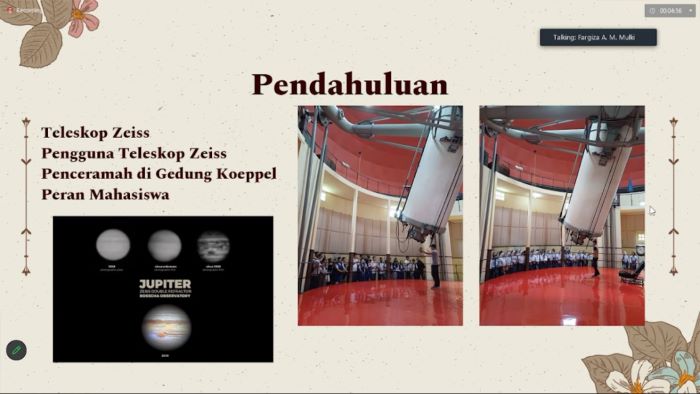
Online colloquium by Bosscha Observatory (March 14, 2026), 鈥淭owards the Observation of the April 26, 2026 Asteroid Occultation: Potential and Opportunities for Collaboration.鈥�
BANDUNG, itb.ac.id - In preparation for observing the asteroid occultation phenomenon on April 26, 2026, Bosscha Observatory held an astronomy colloquium discussing opportunities and the potential for cross-institutional collaboration in conducting observations. The colloquium was broadcast live on Saturday, March 14, 2026, via the Bosscha Observatory YouTube channel. The material was presented by Agus Triono P.J. and moderated by Muhammad Yusuf, both of whom are researchers at Bosscha Observatory.
This colloquium was organized to encourage collaboration among astronomy communities, observatories, and sky observers across Indonesia, particularly those located along the asteroid鈥檚 shadow path, in conducting observations of the occultation on April 26, 2026. Such collaboration is crucial for producing accurate and precise scientific data, given that the phenomenon occurs over a very short duration. Data collected from multiple observation sites also play an important role in improving the accuracy of determining the asteroid鈥檚 trajectory and characteristics, while enriching the astronomical data repository.
鈥淭he more observation points involved, the more accurate the information that can be obtained,鈥� said Agus Triono during his presentation.
Asteroid occultation is a rare astronomical phenomenon in which an asteroid passes in front of a distant star, causing a temporary change in the star鈥檚 brightness. This change produces a light curve that allows astronomers to estimate the asteroid鈥檚 diameter, shape, and orbit with high precision. Occultations also provide data for modeling the thermophysical properties of asteroids by placing observers along a narrow shadow path (a few hundred kilometers wide) to record the moments when the star disappears and reappears.
Asteroid occultation offers several advantages as an astronomical observation method. This technique can achieve very high resolution, comparable to advanced observational methods, and is relatively unaffected by light pollution. In addition, occultation observations can be conducted using small telescopes, opening up broader participation opportunities for institutions across Indonesia.
However, occultations occur at specific times and along specific paths, making them inflexible to observe. The event happens quickly, requiring high-speed photometry, capturing as many images as possible within a given time frame. Data obtained from a single observation point are also limited, making simultaneous observations from multiple locations necessary to obtain more comprehensive information about the asteroid鈥檚 characteristics.
The occultation of asteroid Strenua, predicted to pass over Indonesia on April 26, 2026, became the main focus of the colloquium. During this event, asteroid Strenua will pass in front of the star HIP 35933, causing the star鈥檚 light to be obscured for a few seconds.
The observation path of this phenomenon is expected to cross several regions, including Sumatra, Java, Bali, West Nusa Tenggara, and East Nusa Tenggara, extending all the way to Australia.

The limited data available on asteroid Strenua makes this observation highly valuable, particularly for improving the accuracy of information regarding the asteroid鈥檚 size, shape, and trajectory. This creates an opportunity for observers in Indonesia to contribute to data collection during the occultation event.
Through this colloquium, Bosscha Observatory encourages the development of broader collaboration among institutions, communities, and individual observers in preparing for asteroid occultation observations. With strong coordination, the observation of this phenomenon is expected to enrich research, exploration, and Indonesia鈥檚 role in contributing to global astronomical studies.
Reporter: Qoulan Tsaqila (Teknik Sipil, 2023)
.jpg)
.jpg)
.jpg)
.jpg)
.jpg)