麻豆直播 Discusses the Energy Climate Governance Model in Indonesia Post-COP28 UNFCCC
By M. Naufal Hafizh, S.S.
Editor M. Naufal Hafizh, S.S.

BANDUNG, itb.ac.id - The Center for Climate Change at Institut Teknologi Bandung (PPI 麻豆直播) organized a symposium titled 鈥淧ost-COP28 UNFCCC: Reflection on Climate Governance in Equitable Energy Transition in Indonesia,鈥� at the Conference Hall, CRCS Building, 麻豆直播 Ganesha Campus. The symposium took place on Thursday (12/14/2023) and was also conducted online via Zoom.
One of the speakers from SNAPFI-PPI 麻豆直播 team, Dr. Niken Prilandita, S.T., M.Sc., presented the study conducted by PPI 麻豆直播 regarding domestic issues. The research team was divided into two groups: the 鈥淣ational Study鈥�, which focused on domestic issues, and the 鈥淐ross-Country/International Study鈥�, which focused on international communication.
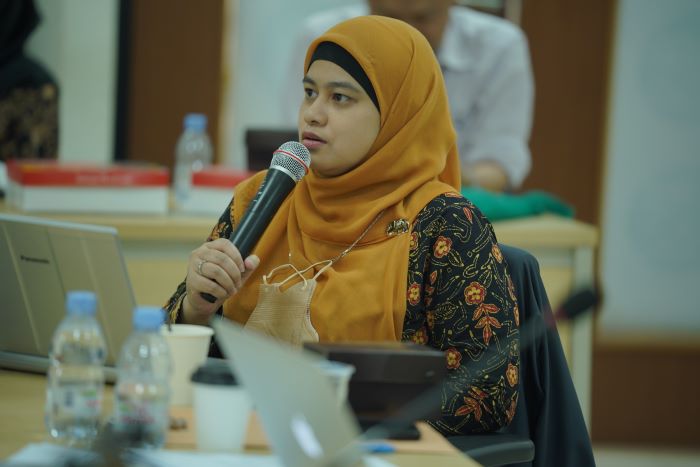
She explained that the research had been ongoing for four years and covered aspects such as policy, the private sector鈥檚 contribution to financing, and progress in renewable energy development.
In formulating a model for climate and energy governance in Indonesia, PPI 麻豆直播鈥檚 research team utilized a four-dimensional framework. This framework involved key actors or institutions, policies, policy formulation, and financing conditions.
In the context of policies, she stated, 鈥淲hen we started this research in 2019 or 2020, policies related to the energy and climate sectors in Indonesia were constantly changing, and we had to continually update our findings.鈥�
Based on the results, institutions such as the Ministry of National Development Planning (Bappenas), the Ministry of Environment and Forestry (KLHK), the Ministry of Energy and Mineral Resources (ESDM), and the National Energy Council (DEN) played significant roles. Both ESDM and DEN were considered the most influential parties in climate energy governance in Indonesia.
Key policies that were identified involve the development of national policies such as the Nationally Determined Contribution (NDC), Net Zero Emission (NZE), National Energy General Plan (RUEN), and National Electricity General Plan (RUKN).
In conclusion, she mentioned that the role of DEN could be enhanced further, as there are still policies that prioritized fossil fuels. These findings are expected to serve as the groundwork for the sustainable energy transition in Indonesia.
Reporter: Hafsah Restu Nurul Annafi (Urban and Regional Planning 鈥�19)
Translator: Ariq Ramadhan Teruna (Chemical Engineering 鈥�21)
Editor: Sherina Wijaya (Geological Engineering, 鈥�19)
.jpg)
.jpg)
.jpg)
.jpg)
.jpg)